


Car Loan in India 2026
A car loan is a financial agreement that allows you to borrow money to purchase a vehicle, which you repay over time with interest. In India, car loans come with low interest rates and can be repaid over up to 8 years. Some lenders may offer loans covering up to 100% of the car’s on-road price.

You can compare the car loan interest rates offered by various lenders to choose the best option. Lenders offer car loans at low-interest rates if your credit score is high.
Compare Car Loans in India 2026
Here's a comparison of some of the best car loan schemes available in 2026, highlighting the starting interest rates and tenure:
Name of the Bank | Interest Rate (p.a.) | Tenure |
7.45% p.a. onwards | Up to 7 years | |
7.45% p.a. onwards | Up to 7 years | |
7.45% p.a. onwards | Up to 7 years | |
7.50% p.a. onwards | Up to 7 years | |
7.50% p.a. onwards | Up to 7 years | |
7.55% p.a. onwards | Up to 7 years | |
Punjab National Bank (PNB) | Floating: 7.60% p.a. onwards Fixed: 8.60% p.a. onwards | Up to 7 years |
Floating: 7.60% p.a. onwards Fixed: 8.50% p.a. onwards | Up to 7 years | |
7.60% p.a. onwards | Up to 7 years | |
7.60% p.a. onwards | Up to 7 years | |
7.65% p.a. onwards | Up to 7 years | |
Floating: 7.75% p.a. onwards Fixed: 8.55% p.a. onwards | Up to 7 years | |
8.00% p.a. onwards | Up to 5 years | |
8.14% p.a. onwards | Up to 7 years | |
8.15% p.a. onwards | Up to 7 years | |
8.40% p.a. onwards | Up to 7 years | |
8.70% p.a. onwards | Up to 7 years | |
8.90% p.a. onwards | Up to 7 years | |
8.99% p.a. onwards | Up to 10 years | |
9.00% p.a. onwards | Up to 7 years | |
Equitas Small Finance Bank | 9.00% p.a. onwards | Up to 7 years |
9.50% p.a. onwards | Up to 7 years | |
Bandhan Bank | 9.47% p.a. onwards | Up to 7 years |
RLLR + 0.75% onwards (Floating) RLLR + 0.25% onwards (Fixed) | Up to 7 years | |
Contact the bank | Up to 7 years | |
Contact the bank | Up to 7 years | |
Contact the bank | Up to 8 years |
Note: Interest rates will differ from one bank to another. This makes it critical to compare interest rates before choosing the best auto loan to apply for.
Fixed vs. Floating Car Loan Interest Rates
Car loans in India come with two types of interest rates:
- Fixed Rate: Stays the same for the whole loan tenure, so your EMI never changes. This makes budgeting simple but the starting rate is usually a little higher than floating.
- Floating Rate: Moves up or down in line with the lender's benchmark rate (linked to the RBI repo rate or MCLR). Your EMI can rise or fall during the loan, but floating-rate loans can come with their own benefits.
Types of Car Loans
The different types of car loans are mentioned below:
- New Car Loan: New car loans can be used to purchase a brand-new car straight out of the showroom. Depending on the bank, the interest rates will vary. Up to 100% of the on-road price of the car may be provided as a loan.
- Used Car Loan: Lenders offer used car loans up to 80-85% of the price of the car at attractive interest rates for a loan tenure up to 5 years. However, certain lenders will offer loans for cars that have been purchased within the last 5 years.
- Loan against Car: When one is in dire need of funds, he or she can pledge his or her old car as collateral in order to obtain sufficient funds to purchase a new car. This is known as Loan against Car. If you have a bad credit score, you can pledge your old car to the bank as collateral to obtain some much-needed funds.
Types of Car Loans
The different types of car loans are mentioned below:
- New Car Loan: New car loans can be used to purchase a brand-new car straight out of the showroom. Depending on the bank, the interest rates will vary. Up to 100% of the on-road price of the car may be provided as a loan.
- Used Car Loan: Lenders offer used car loans up to 80-85% of the price of the car at attractive interest rates for a loan tenure up to 5 years. However, certain lenders will offer loans for cars that have been purchased within the last 5 years.
- Loan against Car: When one is in dire need of funds, he or she can pledge his or her old car as collateral in order to obtain sufficient funds to purchase a new car. This is known as Loan against Car. If you have a bad credit score, you can pledge your old car to the bank as collateral to obtain some much-needed funds.
- Green Car Loan (Electric/Hybrid Vehicle Loan): Some banks, including SBI, offer dedicated loan schemes for electric and hybrid vehicles, sometimes with a lower interest rate and longer repayment tenure than a standard new car loan.
- Car Loan Balance Transfer: Allows you to move your existing car loan to a new lender offering a lower interest rate, reducing your EMI or total interest outgo.
- Top-Up Loan on Car Loan: Some lenders allow you to borrow an additional amount over and above your existing car loan for other personal expenses, using the same car as security.
Key Components of a Car Loan
The main components of a car loan are as follows:
- Monthly Instalments: The EMI that must be paid every month. EMI consists of interest and principal amount.
- Down Payment: The upfront amount paid when you purchase the car.
- Loan Term: The tenure or duration of the loan. EMIs must be paid for the selected tenure.
- Rate of Interest: The interest rate charged by the lender on the Vehicle loan that has been availed.
- Principal Amount: The amount that is borrowed to buy the car. The principal amount does not include any fees or interest levied by the bank.
Down Payment and Loan-to-Value (LTV) Ratio
The Loan-to-Value ratio is the proportion of the car's price that the lender is willing to finance. A higher down payment lowers the LTV ratio, which typically works in your favour:
- A lower LTV reduces the lender's risk, which can help you negotiate a better interest rate.
- A larger down payment means a smaller loan amount, which lowers your EMI and total interest paid.
- For used cars, the LTV is usually calculated on the lender's own valuation of the vehicle, not the price you have agreed to pay the seller, so budget for the difference.
How to Apply for a Car Loan
Online
Most lenders provide the option to apply for a car loan online and the process is mentioned below:
- You will need to visit the official website of the lender to apply for a loan.
- Select ‘Apply Now’ under the car loan section.
- Enter the relevant details.
- The documents can be uploaded.
- A customer service representative will call you to process the request.
You can visit the bank branch and apply for a car loan. The relevant documents must be submitted. Once the verification process is completed, the loan will be provided.
Offline
- You can visit the bank branch and apply for a car loan.
- The relevant documents must be submitted.
- Once the verification process is completed, the loan will be provided.
Eligibility Criteria to Avail a Car Loan
The Car Loan Eligibility Criteria can be different for different banks. The common criteria are as follows:
- The Age of the individual must be between 18 years and 75 years.
- Minimum net monthly income of Rs. 20,000.
- At least one year of employment with the current employer.
- Must be salaried or self-employed, working for a government establishment or a private company.
Documents Required to Avail a Car Loan
To prove your eligibility, you'll need to provide certain documents. Though this too is specific to different lenders, the common documents will be:
Requirements | Individuals |
Identity proof (any of the following) | Aadhaar, Passport, Driving license, Voters ID card, PAN card |
Address proof (any of the following) | Aadhaar, Passport, Driving license, Ration card, Utility bills |
Proof of income | Form 16, Salary slips, if you are salaried, Latest Income Tax Returns, Bank statements going back 6 months. |
Note: Make sure you check exactly what documents the lender wants. The documents required can change depending on your situation too. The documents required to take a used car loan are the same as above.
Checklist to Follow While Applying for a Car Loan
Steps | Requirement | Inference |
Application | Compare all offers available | To find the loan that offers you the highest loan amount and the most affordable interest rate |
Submit Income Proof | Bank Statement (last 6 months) Pay-Slips (last 3 months) IT- Returns (last 2 years) | Lender wants to establish your ability to repay the loan |
Submit Proof of Address and Identity | PAN Card, Voter's ID, Aadhaar Card, Passport, etc. | Lender wants to establish your nationality, identity, and permanent address |
Credit History | Lender wants to check your past credit records and establish if you can be trusted to make regular repayments | |
Information About Vehicle | Sales Receipts from the showroom from where the vehicle was purchased | Lender must confirm that the deal was affected as intended |
Proof of Insurance and Driving License | Copies of the vehicle's Motor Insurance and your Driving License | Lender must establish that all laws and protocols are followed with regard to the purchased vehicle. |
Car Loan EMI Calculator
In case you wish to avail a car loan to purchase a four-wheeler, you can use BankBazaar’s car loan EMI calculator to check the monthly payments. The calculator is easy to use and only basic details such as the loan amount, processing fee, tenure, and interest rate must be entered.
Some of the main advantages of using BankBazaar’s car loan EMI calculator are mentioned below:
- A complete break-up of the amount that needs to be paid will be provided.
- Your budget can be planned as you will know the EMIs.
- Accurate results are provided.
- Helps in saving time as results are displayed immediately.
How to Calculate Car Loan EMI?
The Equated Monthly Installments (EMIs) that you will pay will depend on a few key factors.
The EMI for any type of loan is essentially calculated using a formula. The formula is as follows:
Formula to Calculate Car Loan EMI
E = P x R x (1+R)^n / {(1+R)^n – 1}
where ‘E’ stands for the EMI you owe,
‘P’ stands for the principal amount,
‘R’ stands for the interest rate applicable to your car loan,
and ‘n’ stands for the tenure of the car loan (in months).
- The loan amount
- The interest rate that is applicable to the loan
- The tenure of the loan
- The processing fees
The higher the loan amount, the higher your EMI will be. Similarly, the shorter the loan tenure the higher the EMI. To find the best compromise between an affordable EMI and duration you should check out our car loan EMI calculator.
Choosing the Right Car Loan
- Compare Multiple Lenders: Interest rates, processing fees and prepayment terms vary significantly between banks and NBFCs, so compare the total cost, not just the headline rate.
- Check your Credit Score: Improving your score even by a small margin before applying can meaningfully reduce your rate.
- Decide on your Car and Budget: Finalise the car you want, then check whether the EMI comfortably fits your monthly budget, ideally keeping total EMIs (including any existing loans) within 40–50% of your net monthly income.
- Watch for Hidden Costs: Ask about processing fees, documentation charges, loan insurance and any charges for changing your repayment mode.
- Consider the Tenure Carefully: A tenure of 4–5 years is often a reasonable balance between an affordable EMI and manageable total interest.
- Review the Insurance Costs: Car insurance is a recurring cost and should be factored into your overall affordability check.
Features & Benefits of Car Loans
When it comes to car loans in India, in general, the following features and benefits are offered. Note that the following is a generalised look at the advantages offered by car loans. Individually, lenders may have highly customized and specialized offers for their customer base.
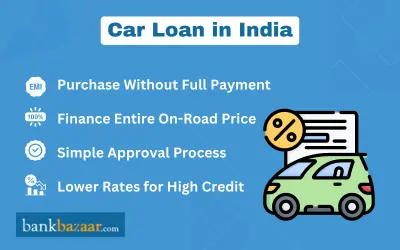
- Car loans in India help you purchase a car even if you don’t have the full amount upfront.
- Most lenders finance the entire on-road price, often with no down payment required.
- Some banks offer loans in crores, giving you wide freedom to choose your car.
- Car loans are usually secured loans, with the car serving as collateral.
- Procuring a car loan is simpler compared to other loans, and even those with lower credit scores may qualify (varies by lender).
- Many loans offer fixed interest rates, ensuring predictable monthly payments.
- Interest rates are often based on your credit score - higher scores can get you cheaper loans.
- Car loans are available for both new and used cars.
Factors that Affect Car Loan Interest Rate
The main factors that affect car loan interest rates are mentioned below:
- Credit Score: The single biggest factor. A score of 750+ typically qualifies you for the lowest advertised rates; a score below 700 usually means a higher rate or a stricter review.
- Income and Job Stability: Higher, steady income and longer tenure with your current employer reassure lenders of your repayment ability.
- Loan Tenure: Shorter tenures often carry marginally lower rates but higher EMIs.
- Down Payment: A higher down payment lowers the lender's risk and can help you negotiate a better rate.
- New vs. Used Car: New car loans attract lower rates than used car loans.
- Relationship with the Lender: Holding a salary account, savings account or fixed deposit with the bank can sometimes secure a preferential rate.
- Women Applicants: Several banks offer a rate concession for women borrowers.
- RBI Policy and Market Conditions: Changes to the RBI repo rate influence floating rates across the market.
Advantages and Disadvantages of Car Loans
The main advantages and disadvantages of car loans are mentioned in the table below:
Advantages | Disadvantages |
|
|
Common Mistakes to Avoid When Availing a Car Loan
Some of the common mistakes that must be avoided when availing a car loan are mentioned below:
- Not comparing car loans from different lenders.
- Choosing the longest possible tenure just to lower the EMI, without checking the total interest cost.
- Ignoring processing fees, insurance costs and other charges when comparing loans.
- Not checking your credit score before applying, which can lead to rejection or a higher rate.
- Overlooking whether the loan is fixed or floating, and what that means for prepayment charges.
- Skipping the fine print on foreclosure terms, especially for fixed-rate loans.


FAQs on Car Loan
1.How much car loan can I get based on my salary?
Most lenders offer up to 80–100% of the car’s on-road price. Loan amount depends on your monthly income, existing EMIs, and credit score.
2.Can I get a car loan with a low credit score?
Yes, some lenders offer car loans even with low credit scores, but the interest rate might be higher. A larger down payment can help improve approval chances.
3.Will my car be hypothecated if I take a car loan?
Yes, the car will be hypothecated to the lender until the loan is fully repaid. Once closed, the hypothecation can be removed from the RC.
4.What car models are financed by the standard car loan in India?
Unless otherwise specified, almost all small to medium sized cars, Commercial Vehicle Loan, Sports Utility Vehicles (SUV), and Multi Utility Vehicles (MUV) come under the purview of car loans available in India.
5.What happens if I miss a car loan EMI?
Missing an EMI may lead to penalty charges, affect your credit score, and eventually lead to car repossession if multiple EMIs are missed.
6.Can I get 100% funding to buy a car?
Yes, certain lenders offer 100% of the on-road price of the car as a loan.
7.Will I get a lower car loan rate if I have a high credit score?
Yes, a good credit score (750 and above) usually qualifies you for lower interest rates and better loan offers.
8.Can I transfer my car loan to another bank for better rates?
Yes, many lenders offer balance transfer options. You can shift your loan to another bank offering lower interest and better terms.
9.When applying for the car loan, do I need a guarantor / security?
Most lenders in India will not insist upon any guarantors; however, if your annual income does not match up to the expected requirement, then you may be expected to sign-up as a co-applicant and/or guarantor
10.What are the commonly available car loan repayment tenures?
Repayment tenures usually range from 12 months to 84 months (1-7 years).
11.Can I pre-pay the entire loan amount? What are the conditions involved?
Yes, you can prepay the entire car loan and save on vital interest payments in the future. However, most banks will allow the pre-payment option after you have chalked off 6 months on your loan tenure.
12.What kind of a credit score do you need to buy a car?
Just like with most loans, a high credit score above 750 is ideal. But you can still apply for a loan if your credit score is above 600.
13.Will my credit score affect the interest rate?
Yes. some banks will offer lower interest rates to applicants with high credit scores.
14.What is the minimum credit score I need to get a car loan?
Most banks and lenders prefer a minimum credit score of 700 for car loan approval. However, some institutions may approve loans for scores as low as 650, though this could result in higher interest rates or require a larger down payment. A score of 750 or above is ideal for better rates and quicker approvals.
15.Should I take a car loan from the car dealership or bank?
Before you apply for any car loan, ensure that you explore all the options available. Once you explore, you will get an idea about the benefits offered by various lenders on their car loans. Compare the benefits offered and pick a lender that fits your requirements. Whether it is a bank or a car dealership, pick the one that offers better interest rates.
16.Do banks offer finance for used cars?
Yes, many top lenders such as SBI, HDFC Bank, etc., offer loans to buy used cars.
17.How much down payment do I need to make to buy a car?
Making a higher down payment will mean that you will need to avail a lower loan amount to buy a car. When you avail a lower loan amount, there are chances that banks or lenders may offer you a car loan at lower interest rates.
18.What will lenders look for when I apply for a car loan?
One of the most important factors that lenders consider before offering you a car loan is your credit score, The other factors that lenders look for when you apply for a car loan are your employment status, residence and job stability, income, debt-to-income ratio, etc.
19.What is the lowest EMI that I need to pay for a car loan?
The amount of EMI (equated monthly instalments) that you will be paying towards your car loan will depend on the interest rate, loan amount, and the repayment tenure you choose. You can calculate the EMI by using the EMI Calculator tool available on the BankBazaar website.
Latest Car Loan News and Updates
HDFC Bank Securitizes Rs. 12,700 Crore in New Car Loans
HDFC Bank, India's largest private sector lender, has securitised new car loans worth over Rs. 12,700 crore by issuing Pass-through Certificates (PTCs). The move is expected to boost the bank's liquidity. According to a late-night statement from India Ratings, the pool of loans originated by HDFC Bank will be assigned to a trust. The rating agency has given these PTCs an 'AAA/stable' rating, with maturities ranging between two and six years. The securitisation pool comprises 0.18 million loans with an aggregate outstanding principal of Rs. 12,371.8 crore as of 31 October 2024. The loans, all classified as standard assets, have a weighted average Internal Rate of Return (IRR) of 8.91% and a robust repayment history. Approximately 42.7% of the loans in the pool are from the top three states. As of September 2024, HDFC Bank reported gross advances of Rs. 25.19 trillion, with auto loan assets under management, including new car loans, amounting to Rs. 1.3 trillion.
Three New Cars to Be Launched by Tata
Tata Motors is set to launch three new cars. Among them will be an electric car. The electric car that will be launched by Tata is the Curvv. The other two cars that will be launched by the company are the Altroz Racer and the Nexon CNG. The Nexon CNG will be powered by a 1.2-litre engine, while the Altroz Racer will be powered by a 1.2-litre turbo petrol engine. The first car that will be launched will be the Tata Curvv.
Car Loan Articles
- Car Prices in India
- How To Transfer a Car Loan to Another Person
- How GST Affected Car Prices in India
- Car Lease Vs Car Loan
- Car Loan Foreclosure Procedure
- Vehicle Registration
- Car Loan Document Checklist
- Bad Credit Car Loan
- Car Loan Refinancing
- Zero Downpayment Car Loan
- Commercial Car Loan
- Car Loan for Nris
- Car Loan Schemes for Women
- Car Loan Preclosure
- Transfer Car Registration
- Top 10 Banks for Car Loan
- Car Loan Schemes for Government Employees
- Fuel Efficient Sedan Cars
- Automatic Cars for Women
- Chepest Cars in India

Disclaimer
Credit Card:
Credit Score:
Personal Loan:
Home Loan:
Fixed Deposit:


Copyright © 2026 BankBazaar.com.